Design/Build Dealer Website Template
Design/Build Dealer Website Template
Design/Build Dealer Website Template
A flexible website design template created for PCR’s design/build-focused foodservice dealers, balancing project-driven storytelling with streamlined equipment browsing and a highly adaptable visual system.
Year :
2026
Client :
PCR- PRIDE Centric Resources
My Role:
Design
Prototyping
Design Systems
Tools:
Figma
Claude
Industry:
Foodservice

Problem :
PCR supports a wide range of foodservice equipment dealers, but dealers with strong design/build capabilities have different website needs than those primarily focused on equipment sales.
Their websites need to communicate expertise through completed projects, planning capabilities, and real-world environments while still providing access to large equipment catalogs. A traditional equipment-heavy dealer site can make it difficult for project work to stand out, while a heavily branded custom design can be difficult to reuse across multiple dealers.
The challenge was to create a repeatable design direction that could support both needs without feeling generic.
Solution :
I designed a minimal, architectural website template that places project imagery and design/build expertise at the center of the experience.
Large photography, restrained layouts, generous whitespace, and strong typographic hierarchy give completed work room to speak for itself, while equipment pages use a more functional, understated system built around search, filtering, product specifications, and quote requests.
The visual foundation is intentionally neutral so PCR can easily adapt the template to individual dealer brand standards, including colors, typography, logos, and imagery, without redesigning the underlying experience.
Process :
I began by identifying the content and functionality shared across PCR dealer websites, then separated those requirements into two primary experiences: project storytelling and equipment discovery.
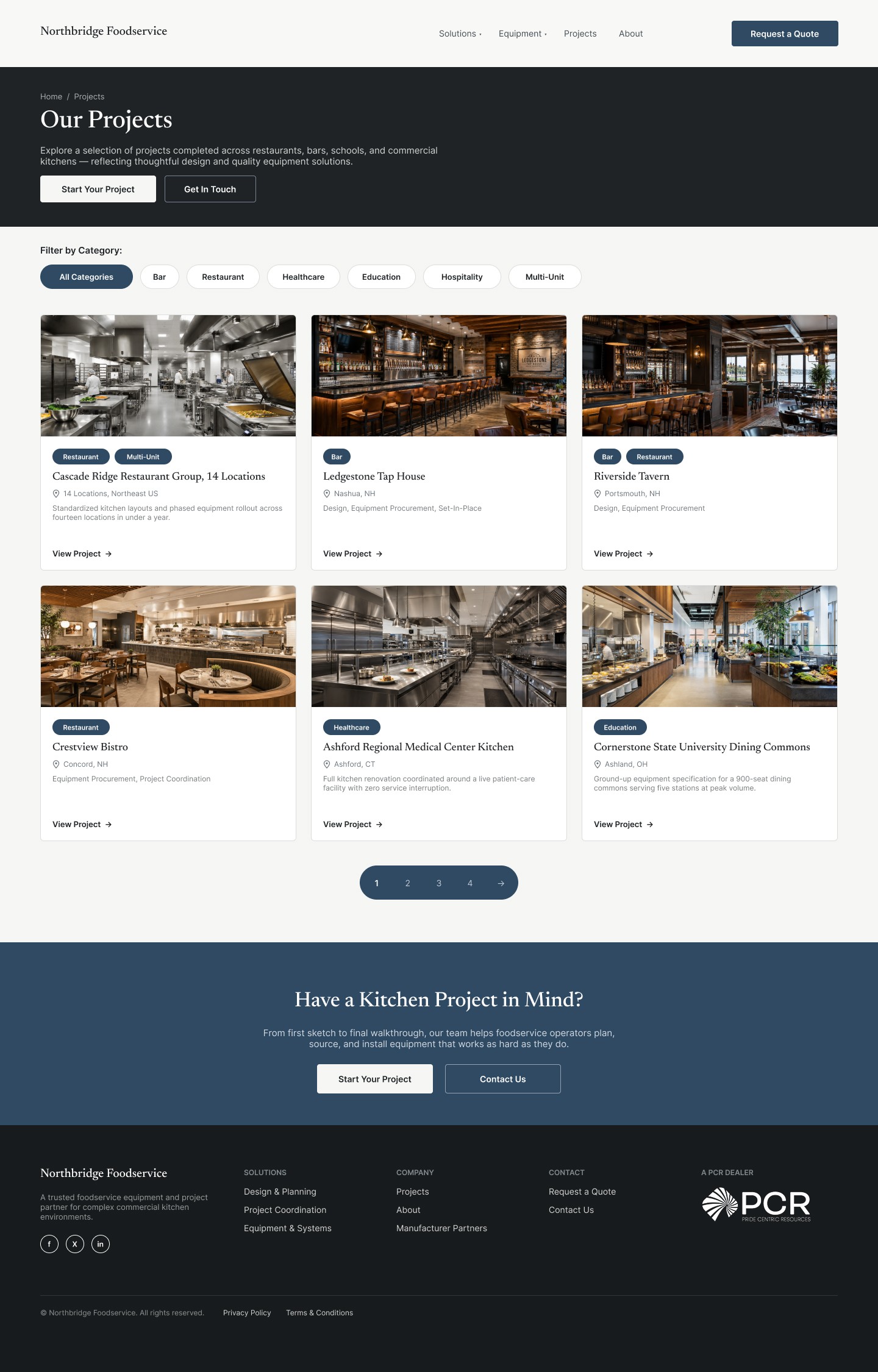
For project-focused pages, I developed layouts that prioritize imagery, services, project details, and completed work. The homepage introduces design/build capabilities immediately and carries that visual emphasis through featured projects, manufacturer relationships, and service information.
Equipment pages were intentionally simplified. Product categories, filtering, quote functionality, and specifications remain easy to access, but the interface stays visually secondary to the dealer’s project portfolio.
I also designed reusable systems for project archives, individual case studies, product archives, product details, calls to action, navigation, and footer content. Each component was created with future customization in mind so PCR can change brand elements without disrupting the structure or hierarchy of the template.
Outcome :
The final template gives PCR a scalable starting point for future dealer websites that specialize in design/build work.
Rather than forcing every dealer into the same equipment-first experience, the system provides a distinct design direction for businesses whose completed projects and planning expertise are central to their value proposition.
Its neutral, architectural foundation allows each implementation to feel specific to the dealer while reducing the amount of design work required to launch future sites. The result is a reusable framework that supports stronger project storytelling, clear equipment discovery, and consistent UX across PCR’s dealer network.


More Projects


Design/Build Dealer Website Template
Design/Build Dealer Website Template
Design/Build Dealer Website Template
A flexible website design template created for PCR’s design/build-focused foodservice dealers, balancing project-driven storytelling with streamlined equipment browsing and a highly adaptable visual system.
Year :
2026
Client :
PCR- PRIDE Centric Resources
My Role:
Design
Prototyping
Design Systems
Tools:
Figma
Claude
Industry:
Foodservice
Problem :
PCR supports a wide range of foodservice equipment dealers, but dealers with strong design/build capabilities have different website needs than those primarily focused on equipment sales.
Their websites need to communicate expertise through completed projects, planning capabilities, and real-world environments while still providing access to large equipment catalogs. A traditional equipment-heavy dealer site can make it difficult for project work to stand out, while a heavily branded custom design can be difficult to reuse across multiple dealers.
The challenge was to create a repeatable design direction that could support both needs without feeling generic.
Solution :
I designed a minimal, architectural website template that places project imagery and design/build expertise at the center of the experience.
Large photography, restrained layouts, generous whitespace, and strong typographic hierarchy give completed work room to speak for itself, while equipment pages use a more functional, understated system built around search, filtering, product specifications, and quote requests.
The visual foundation is intentionally neutral so PCR can easily adapt the template to individual dealer brand standards, including colors, typography, logos, and imagery, without redesigning the underlying experience.
Process :
I began by identifying the content and functionality shared across PCR dealer websites, then separated those requirements into two primary experiences: project storytelling and equipment discovery.
For project-focused pages, I developed layouts that prioritize imagery, services, project details, and completed work. The homepage introduces design/build capabilities immediately and carries that visual emphasis through featured projects, manufacturer relationships, and service information.
Equipment pages were intentionally simplified. Product categories, filtering, quote functionality, and specifications remain easy to access, but the interface stays visually secondary to the dealer’s project portfolio.
I also designed reusable systems for project archives, individual case studies, product archives, product details, calls to action, navigation, and footer content. Each component was created with future customization in mind so PCR can change brand elements without disrupting the structure or hierarchy of the template.
Outcome :
The final template gives PCR a scalable starting point for future dealer websites that specialize in design/build work.
Rather than forcing every dealer into the same equipment-first experience, the system provides a distinct design direction for businesses whose completed projects and planning expertise are central to their value proposition.
Its neutral, architectural foundation allows each implementation to feel specific to the dealer while reducing the amount of design work required to launch future sites. The result is a reusable framework that supports stronger project storytelling, clear equipment discovery, and consistent UX across PCR’s dealer network.
More Projects
Design/Build Dealer Website Template
Design/Build Dealer Website Template
Design/Build Dealer Website Template
A flexible website design template created for PCR’s design/build-focused foodservice dealers, balancing project-driven storytelling with streamlined equipment browsing and a highly adaptable visual system.
Year :
2026
Client :
PCR- PRIDE Centric Resources
My Role:
Design
Prototyping
Design Systems
Tools:
Figma
Claude
Industry:
Foodservice
Problem :
PCR supports a wide range of foodservice equipment dealers, but dealers with strong design/build capabilities have different website needs than those primarily focused on equipment sales.
Their websites need to communicate expertise through completed projects, planning capabilities, and real-world environments while still providing access to large equipment catalogs. A traditional equipment-heavy dealer site can make it difficult for project work to stand out, while a heavily branded custom design can be difficult to reuse across multiple dealers.
The challenge was to create a repeatable design direction that could support both needs without feeling generic.
Solution :
I designed a minimal, architectural website template that places project imagery and design/build expertise at the center of the experience.
Large photography, restrained layouts, generous whitespace, and strong typographic hierarchy give completed work room to speak for itself, while equipment pages use a more functional, understated system built around search, filtering, product specifications, and quote requests.
The visual foundation is intentionally neutral so PCR can easily adapt the template to individual dealer brand standards, including colors, typography, logos, and imagery, without redesigning the underlying experience.
Process :
I began by identifying the content and functionality shared across PCR dealer websites, then separated those requirements into two primary experiences: project storytelling and equipment discovery.
For project-focused pages, I developed layouts that prioritize imagery, services, project details, and completed work. The homepage introduces design/build capabilities immediately and carries that visual emphasis through featured projects, manufacturer relationships, and service information.
Equipment pages were intentionally simplified. Product categories, filtering, quote functionality, and specifications remain easy to access, but the interface stays visually secondary to the dealer’s project portfolio.
I also designed reusable systems for project archives, individual case studies, product archives, product details, calls to action, navigation, and footer content. Each component was created with future customization in mind so PCR can change brand elements without disrupting the structure or hierarchy of the template.
Outcome :
The final template gives PCR a scalable starting point for future dealer websites that specialize in design/build work.
Rather than forcing every dealer into the same equipment-first experience, the system provides a distinct design direction for businesses whose completed projects and planning expertise are central to their value proposition.
Its neutral, architectural foundation allows each implementation to feel specific to the dealer while reducing the amount of design work required to launch future sites. The result is a reusable framework that supports stronger project storytelling, clear equipment discovery, and consistent UX across PCR’s dealer network.